Master Key Systems in Milpitas
Quoted after the doors are walked and counted. One key sitting above a key for a landlord holding a row of units at the business park, an owner with shops and offices in Midtown, or a building where a stair, a utility room and a mailbox bank all have to answer to the manager. No range is published because the chart has to exist before the figure does, and drawing the chart takes an hour with a notebook.
4.9 / 5· 207 reviews from Milpitas and the north end of the valley
custom quote
Typical price
18 min
Avg. arrival
24/7
Availability
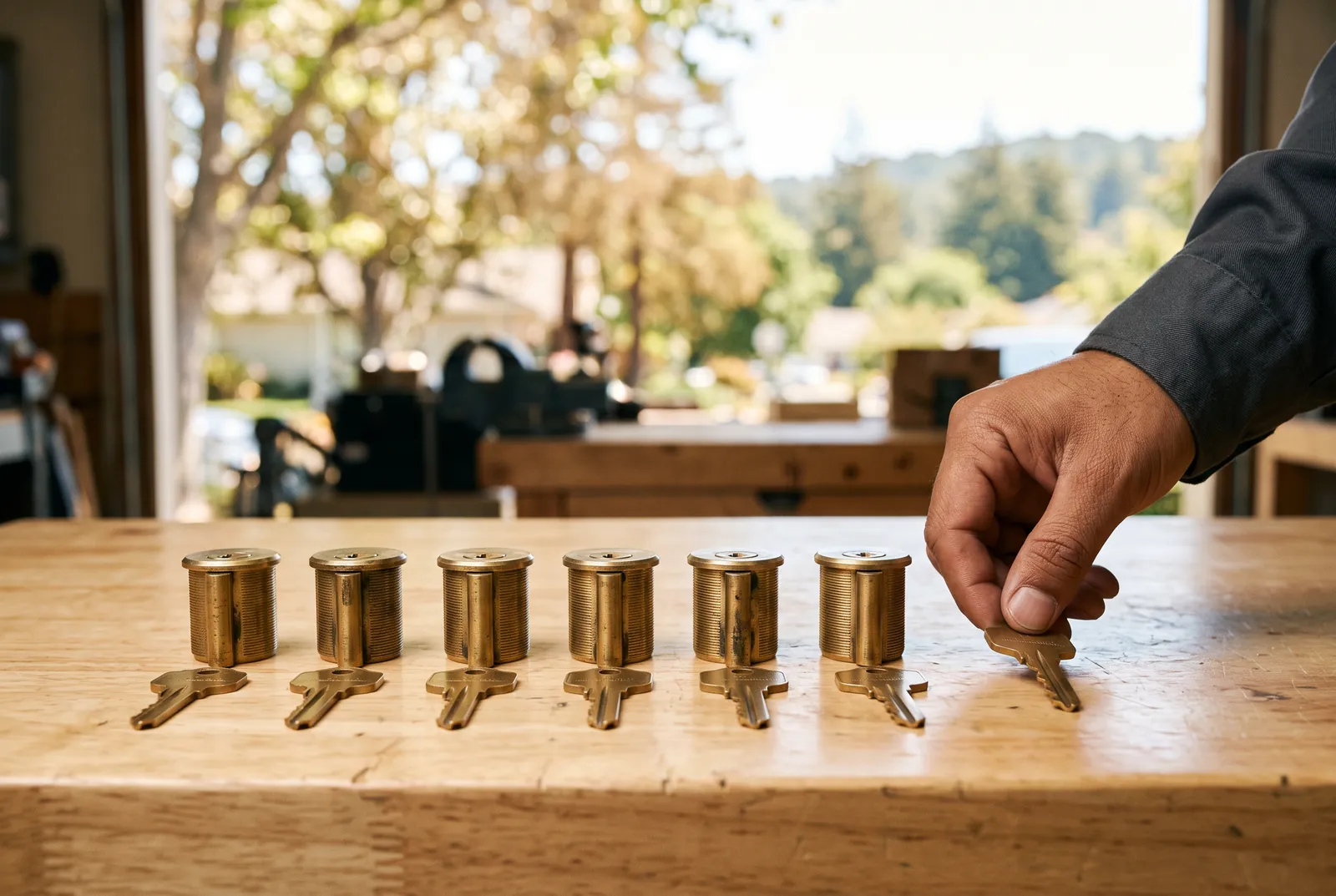
What a master key system really is, is a hierarchy made of metal. A tenant, a department or a crew opens the door that belongs to them and nothing past it. A master covers a floor, a row of suites or a whole site. Above that there is sometimes a grand master for an owner or a manager. Done properly, the drawer full of unlabeled keys becomes one key that is worth looking after. Done carelessly, it hands out keys that open doors nobody meant them to open, which is a worse position than having no system.
That is why no figure goes out over the phone. Every opening gets walked and counted first: the hardware hanging in it, whether those cylinders can carry the pinning, who has to reach it, and which doors must be kept out of the system altogether. There is always at least one of those and normally more than an owner expects. A server room. A records cabinet. A supply closet with controlled stock in it.
In Milpitas this work concentrates in two places. First, the business park and the warehouse rows at McCarthy Ranch and off 237, where one tenant may hold a dock, a yard gate, a shop floor, a parts cage and four offices, and where the site is deserted by six with nobody left on it to lend a key. Second, the complexes, where the chart covers the half of the property nobody ever counted: electrical and telecom rooms, riser and stair doors, the trash room, janitor closets, the pump room, the roof hatch, the walk-in gate beside the garage ramp. That layer is normally a ring of faded keys in a drawer in the management office, and organizing it is exactly what a chart is for. A third, smaller shape keeps recurring too: an owner holding several rental houses across Parktown and Milpitas Manor, for whom one restricted keyway across the portfolio does more good than anything else on this page.
The chart is the real job, and pinning it is an afternoon. Levels go on paper after the walk, a restricted keyway sits under the whole thing so nothing can be copied at a machine in a grocery store, and each cylinder is pinned at the bench with master pins stacked over change pins, then tried in its own door with both keys. Cylinders with life left in them are repinned into the chart rather than thrown out, which is usually the biggest single saving on the quote. Keys are stamped by level and signed for in a log. You keep a chart that sets every door against every key that opens it, with blank rows for whatever gets added next year.
The figure is one itemized quote after the walk, because door count, level count, keyway choice and the state of each cylinder move it too far for any published range. The $89 survey is the visit and it counts toward the work. Once approved, the quote holds. One door repinned later, when somebody leaves, is $30 to $47 and stays inside the chart. Ninety days on the workmanship.
“I own three shops and two offices over them in Midtown, and for years every door had its own key on a ring I hated carrying. He spent an hour with a notebook walking and counting doors before quoting anything, which is why the chart he drew actually matches what's on the building. One key opens everything I own now, the cleaners hold a key that opens nothing upstairs, and the mailbox bank is finally on the same system.”
All sixteen jobs are printed here, fourteen with ranges and two quoted once the doors have been walked. What moves a figure inside its range is which lock on the way in stopped you and how long that lock has stood unused. A front door somebody opens twice a day takes the low end. A gate latch nobody has walked through since the complex opened is dry, full of grit and often will not take the key that was cut for it, and that takes the time it is owed. Say which one stopped you and the range closes to a single figure.
- Daytime (7am–8pm)standard rates
- Evening (8pm–12am)+$48
- Overnight (12am–7am)+$86
FAQ
Master Key Systems: quick answers
Our complex runs on cards and remotes. Why would we need keys at all?+
Because the electronics went onto the doors residents actually use, and every property like yours has a second set that never got any: risers, telecom and electrical rooms, the pump room, the trash room, janitor closets, the roof hatch, the walk-in gate by the ramp. Those are all metal, and they are the least organized part of the place. One chart puts them in order, with a master that reaches all of them and change keys that reach one.
Why will nobody price this over the phone?+
Three things set the figure: how many doors there are, how many levels the chart needs, and what condition each cylinder is in. A phone call supplies none of the three. A number given without the walk is a guess, and the correction shows up when half the cylinders are already on the bench and the chart has to be redrawn.
Our property manager left the job and the master for the building never came back.+
The chart tells you exactly which doors that key reached, so the repinning stops there and nothing else has to move. Change keys and any sub-masters under them keep working. Because the keyway is restricted, no counter machine ever cut a copy, so what is loose in the world is one key and not an unknown number of them. Door count on the chart sets the price, and you have it before work starts.
Related
More commercial services
Open 24 hours, 7 days
Name the door, and say who else has a key for it
Milpitas, at any hour, every day of the year. A front door in the tracts, a gate at a complex, a garage service door, a storefront in Midtown or a car in the mall lot — that decides the work, and the work decides the figure. The figure comes back on the same call with the $89 call-out and the clock already inside it, and it is the figure on the receipt. Ninety days on the labor, in writing. The van is already on this side of the interchange.