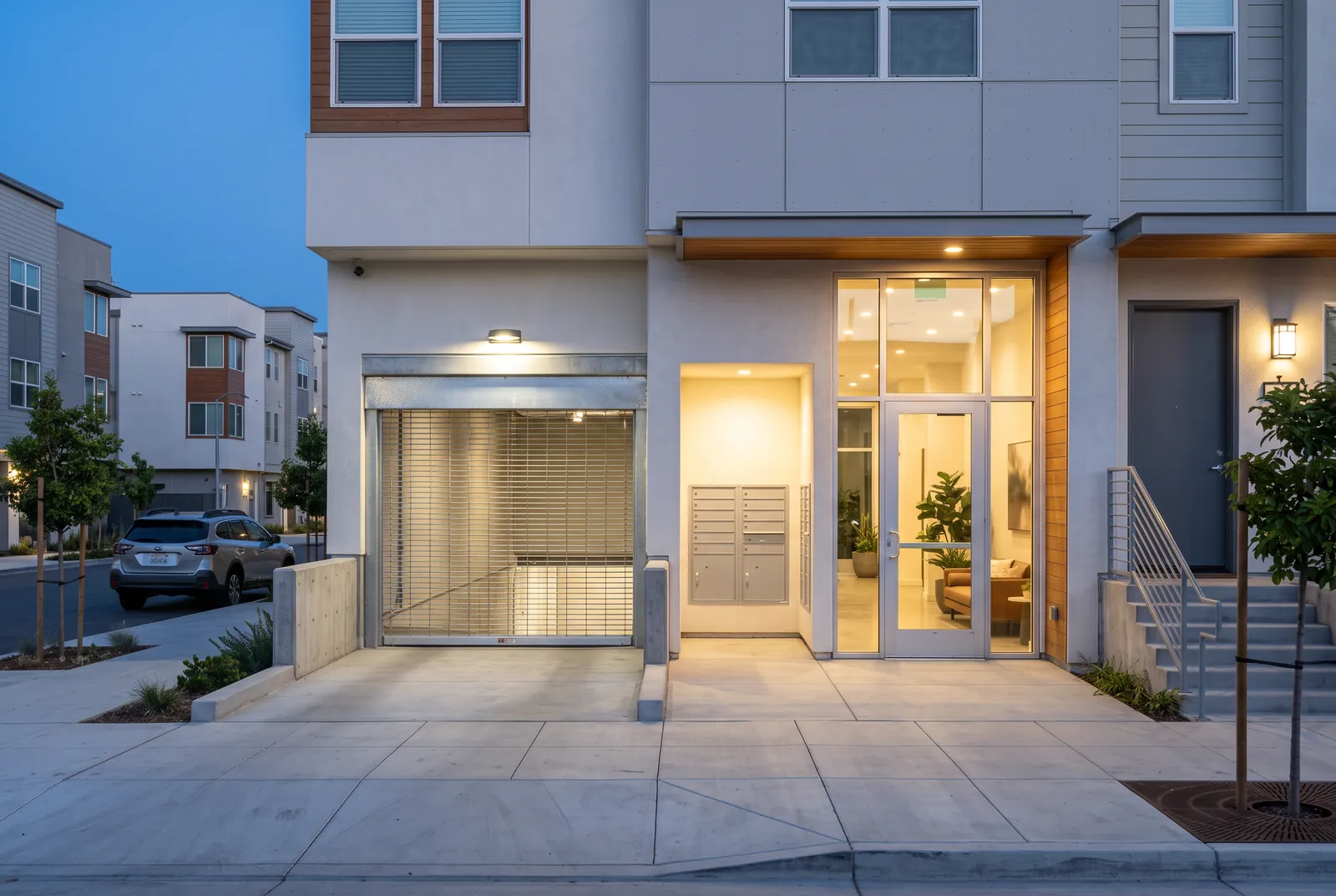
Standing at the curb with two bags, counting what is between you and the sofa
Stop on the sidewalk outside one of the newer blocks and count. To your left the ground falls away down a ramp to a rolling steel leaf with a pedestal beside it. Straight ahead, a glass door in a dark aluminum frame with a long vertical pull and a lit hall behind it. Inside that hall, in a recess to one side, two grids of small metal doors and a plain door next to them with a code pad. Then an elevator, then a corridor, then a door with a number on it.
Four locks, and none of them behaves like the other three. A person coming home crosses all four in about a minute without thinking about any of them, holding a phone, a coffee and a bag of groceries. It only becomes a subject when one of them stops, and then the first useful question is not what broke. It is which of the four you are standing at.
That question decides everything after it: who can authorize the work, whether it is even this trade, what it costs, and how long it takes. Getting it wrong on the phone is the most common reason a visit takes twice as long as it needed to. So here they are in order, from the street inward.
The ramp gate, which is a machine rather than a lock
The first one is the vehicle gate at the top of the ramp, and it is the odd one out: there is no keyhole in it anywhere. It is a motor, a drive chain or a rack, a loop of wire buried in the concrete that feels a car standing over it, a safety beam across the opening, a receiver listening for remotes, and a keypad or call box on a post. When it quits, it quits as a machine, and that is the gate contractor's trade rather than a locksmith's.
The part of it that is this trade is the walk-in gate a few steps to the side, which nearly every ramp has: a steel frame, a latch, and an ordinary cylinder. That cylinder is the most useful lock on the whole property and the least maintained one, standing outdoors with sun on one face and wind-blown grit collecting in the keyway. Rekeying it with a key cut to match is $30 to $47, and where the shell or the cam has worn out, replacement is $126 to $338.
Worth knowing before you need it: whether your key opens that walk-in gate. Try it on a Saturday. Half the residents who call from a stalled ramp are carrying a key that would have let them walk in and get upstairs, and they have never turned it in that gate.
The lobby leaf, which is a latch and not a deadbolt
The second lock is in the glass door at the front. This is storefront hardware, the same family as the doors on a shop front, hung either on hinges down one side or on pivots at the head and the threshold, with an arm overhead that brings it back. What holds it shut is usually not a deadbolt but a latch with a small plunger beside it that rides on the strike and keeps the latch from being pushed back once the door is closed.
It fails in three separate ways and they get confused with each other constantly. The electronic half stops, which leaves the mechanics untouched. The overhead arm weakens or the leaf drops a fraction, so the door drifts up to its strike without the push to seat, and then it looks shut while standing an eighth of an inch open. Or the cylinder in the leaf, the one nobody has turned since the building was handed over, seizes. That third one is never noticed on its own. It is discovered on the morning one of the other two happens.
Work on this door is storefront hardware at $159 to $486, or an opening at the building's instruction as a business lockout at $142 to $265. Getting the leaf hanging square and the arm adjusted is usually the more valuable half of the visit, because a door that seats itself properly stops needing anybody's attention for years.
The mail block and the parcel room: small locks, own keys, own rules
The third lock is really a cluster of small ones, and they are a different trade inside the same trade. A mail block takes flat cam locks with short stubby keys, an inch and a half of brass that lives loose in a pocket and gets lost twice a year. Beside it there is often a room where parcels get left, on a code pad, sometimes tied to the building's system and sometimes running on its own set of cells with nobody in the building holding an account for it.
The distinction that matters to a resident is who owns the metal. Where mail arrives in a cluster box that a carrier opens from the back, the lock in your little door is arranged through the postal service rather than through us, and that is a call to them. Where mail lands in a hall cabinet inside the building, those are ordinary small cylinders and this trade works on them like any other lock.
The parcel room is where the battery unit catches people out. A code pad on an interior door gives a warning for a few weeks that nobody is watching for, and then it stops. Almost every one of them has a keyway somewhere on the housing, and a key for that keyway that has never been cut is the normal state of affairs rather than the exception. Cut one in daylight for $30 to $47 and the same door stops being an event.
The unit door, which is the only one entirely yours
Upstairs it becomes simple. The door with your number on it is a cylinder, a latch, usually a deadbolt above it, occasionally a chain. On most buildings there is nothing electronic in it, no list behind it, nobody else's contract attached to it. It is the same object as a front door on a flat street in Parktown, and it gets worked on the same way.
Which is why it is the one door in the sequence where you decide. Rekeying it is $30 to $47 per cylinder and takes about twenty minutes, and afterward every key cut for it before that afternoon is scrap: the one the last resident kept, the one a cleaner had, the one somebody's cousin has been carrying since a house sitting week two years ago. Getting back into it when it has shut behind you is a house lockout at $129 to $246 with the $89 service call inside the figure, plus $48 between 8pm and midnight or $86 between midnight and 7am. Replacing a cylinder that has given up, with its hardware, is $126 to $338.
The odd thing is that this is usually the only lock of the four in good working order, and it is the only one anybody thinks about. Three shared locks stand between it and the street, carrying the whole building's traffic and the weather, and they get no attention at all until one of them strands somebody in the dark.
At six in the morning and after nine at night the hall is empty
In an older city, a lobby that will not open is a nuisance because somebody is always coming or going. Here it is different, and the difference is the reason this article exists. The blocks around the Transit Area empty out inside the same twenty minutes in the morning and refill in the same hour at night. Between those two peaks there is nobody in the hall to let you in, and the office is a door with a notice on it.
So the failure lands at the worst two moments by simple arithmetic: you are at the door either before anyone has left or after everyone has come home and shut their own door. A neighbor with a key is not a plan here the way it is on an old street, because the neighbor keeps your hours. Neither is the spare key in your partner's bag, which is somewhere between the 880 and the 237 at exactly those hours.
Which leaves the two things that do work: knowing which of the four locks you are at, and knowing which number gets answered at night. Both are free, both take a Saturday afternoon to establish, and between them they take an hour off the worst version of this evening.
Four names, four numbers, and one short phone call
Say the name of the lock and the call gets short. Ramp gate, walk-in gate, lobby leaf, mail block, parcel room, unit door. That one phrase decides whether this is even the right trade to be calling, what comes off the shelf in the van, and which figure applies: $129 to $246 on your own door, $142 to $265 on a shared entrance opened at the building's instruction, $159 to $486 for storefront hardware, $30 to $47 a cylinder for a rekey.
On the shared locks there is one more step and it happens on the phone rather than in the hall. Those doors serve the whole building, so before a van is sent we ask who is authorizing the work and take it from them. That is a matter between you and the people who manage your building, and it is not something decided on a doorstep. On your own unit door there is no such step: identification at the door, and the work starts when you say so.
Arrival averages 18 minutes across the city from the base near Main Street, with the Transit Area at 14, Midtown at 13 and Hidden Lake Village at 19. A cross street is worth more than a building name, because several of these blocks look identical from the road and two of them share a driveway. Ninety days on the labor, printed on the receipt.
Quick answers
The lobby door will not open and my key is for my apartment only. What now?+
Two things at once. Call whoever answers for the building at night, because that door and its electronics belong to them. Then, if it has to be opened, that is a shared entrance and we ask who is authorizing the work before a van is sent. It is a business lockout at $142 to $265, and a seized cylinder in the leaf is storefront hardware at $159 to $486.
Can one key open the gate, the mail block and my apartment?+
Your own locks usually can go onto one key: the unit door, the mail cabinet if it is inside the building, a storage cage padlock, at $30 to $47 per cylinder. The shared entrances are a different matter, because any change there is arranged with the building rather than by a resident. In practice the tidy-up worth doing is the set of locks that are yours.
Is the ramp gate something you can open at night?+
The vehicle gate itself is a motor, a sensing loop and a safety beam, and that is the gate contractor's work. What we open and service is the walk-in gate beside it, the door from the garage into the stairwell, and the cylinders on the small doors down there. Naming which of the two you are standing at on the phone saves everybody a wasted trip.
Need it handled rather than read about?
(669) 330-0824More guides