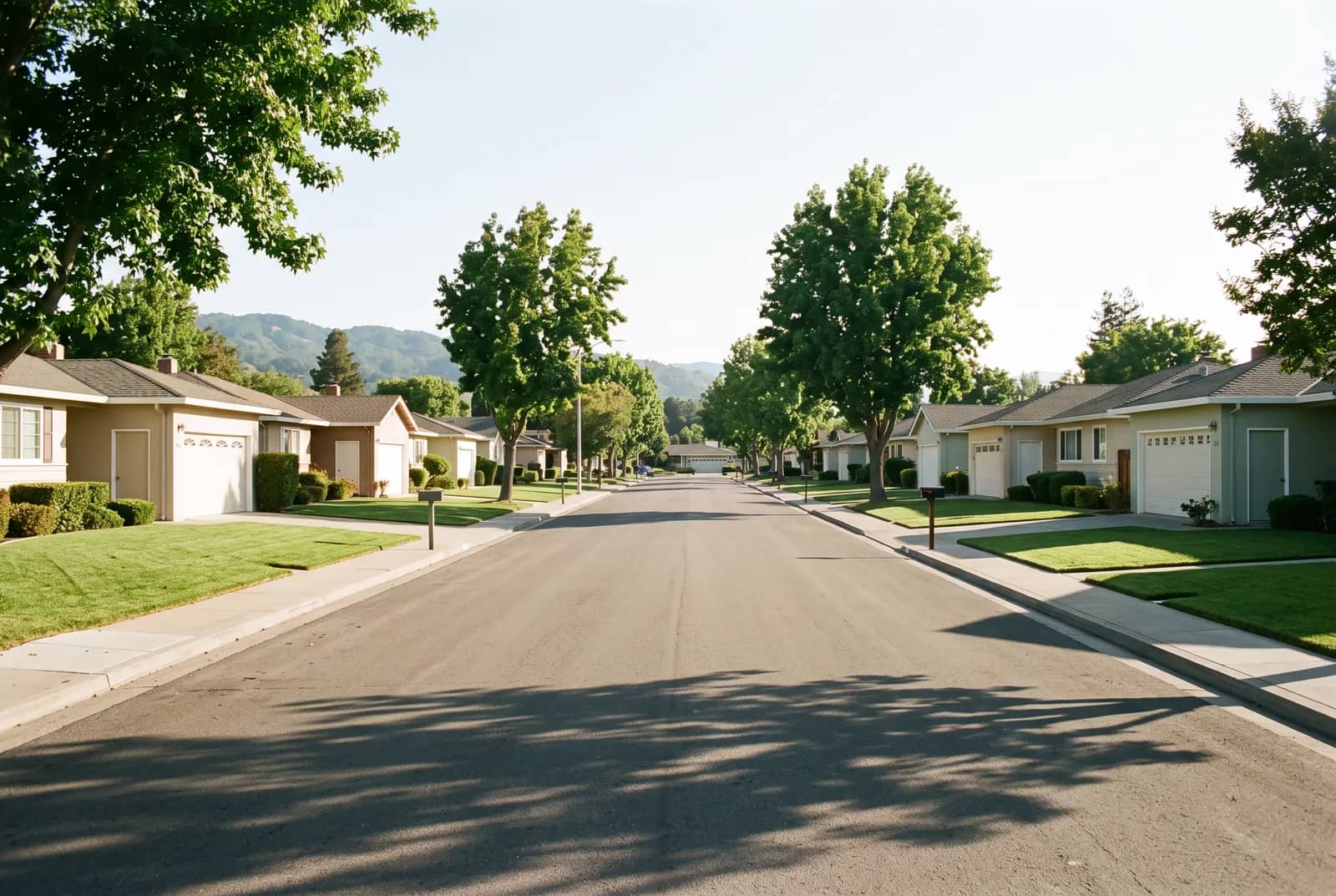
Twenty past six, and every driveway on the block is already empty
The porch light is still on because it runs off a timer. You carried the recycling bin down to the curb in a sweatshirt, the front door swung back behind you, and the latch caught. It is a Tuesday on a flat tract street, the sky is the color of wet cement, and the block runs four hundred feet in each direction with nothing moving on it. One garage across the way stands open and empty, which tells you that household pulled out about twenty minutes ago.
Anyone who grew up in an older town has a reflex for this moment, and here the reflex reaches for things that were never built. No hardware store two blocks over with somebody behind the counter who cuts keys. No doorman, no booth at the entrance, no building super in a basement, because this city went up after 1960 in whole tracts at a time and none of those jobs came with it. The neighbors you would knock on are not asleep. They are gone.
Meanwhile the spare key exists. It is cut, it turns, and it is on a ring in a cup holder in a car that is somewhere past the place where the freeways cross. Six miles away on a map and forty-five minutes away on the clock. That gap is the entire problem, and it is why this city produces the call it does at both ends of the day.
The three answers that work in other towns, and what they do here
Answer one is the neighbor who keeps your key. It is the best answer anywhere and the weakest one on this street, because a block full of commuters empties inside the same twenty minutes every morning and fills again in the same hour at night. The person who could walk over with your key is on the same road as your key. When it comes back at seven in the evening, so do they, and the two arrivals are not independent of each other.
Answer two is an office. On a single-family street there is no office to call. In a complex there is one, and the notice by the mailboxes has a number on it, and that number is answered during business hours by somebody in a room that opens at nine. The after-hours line, where there is one, usually reaches a person who is not in the city and who will tell you, reasonably enough, to get a locksmith out.
Answer three is a copy kept somewhere else: a desk drawer, a relative in Fremont, a friend in Santa Clara. On a quiet map those are 27 and 31 minutes out. At seven in the morning they are not, and the trip is two of those numbers rather than one, because somebody has to drive both directions. A spare key that is only reachable by crossing the interchange twice is a spare key on paper.
Call the person with the key, and ask where rather than when
Make the call first, and change the question. Do not ask how long they will be. Ask where they are exactly: which freeway, which direction, which exit they last went past. A driver in stopped traffic will say twenty minutes because that is what the trip usually takes, and the number is a hope rather than an estimate. An exit name is a fact you can do arithmetic with.
Three freeways come together at the edge of this city, which is a fact about the trip and not a complaint about the road. Somebody who has already passed the crossing heading away from you has to come off, turn back and come through the same knot a second time. On an ordinary weekday that is an hour. Knowing it is an hour is worth more than being told twenty minutes four times in a row.
Ask the second question as well, because it settles a good share of these calls before anything else happens: is the key actually on them right now. Spare keys live in jacket pockets and console trays and gym bags, and the honest answer is often that it is in the kitchen drawer, on the other side of the door you are standing in front of.
Ninety seconds of checking, before anybody drives anywhere
Work out which lock actually caught. A latch that closed on its own is one job. A deadbolt you turned with your thumb on the way out is another. A key that snapped off in either is a third, and it is the one where pulling on the stub makes things worse. Saying which of the three on the phone decides what comes off the shelf in the van before it leaves, rather than being fetched afterward.
Then walk the house, because a tract house here has three ways in and only the front one ever gets any thought. There is the service door from the garage into the hallway. There is a patio slider at the back. There is a gate down the side of the house to reach that slider. If the big garage door still answers to a remote in the car or to the keypad by the driveway, the service door behind it is often unlocked, and a fair number of six o'clock calls end with somebody finding that door while we are still on the phone. No charge for that, and it is a better outcome than ours.
What not to do is a shorter list. A card will not move a deadbolt, and on a latch it mostly ruins the card and marks the paint. A slider levered up off its track costs more to set right than the opening ever would. Anything that leaves damage on the jamb moves the job out of a house lockout at $129 to $246 and into repair work at $172 to $455, which is a poor trade at any hour of the night.
What happens when the van reaches the door
Identification with the address on it, or identification plus something that ties you to the house, comes first at the door. That holds at six in the morning in slippers, and it is the part of the visit that protects the person who is actually locked out. Then the opening. Where the mechanism allows it, the lock is picked and goes on working afterward, which is the point: a door that opens and then still locks that night has not cost you a second visit. Drilling is said out loud before it happens and it is the last choice rather than the quick one.
A house lockout is $129 to $246, with the $89 service call sitting inside that figure rather than being added at the end of it. An arrival between 8pm and midnight carries $48. One between midnight and 7am carries $86. Both are named on the phone before anyone starts driving, so the number you agree to is the number on the receipt. Ninety days on the labor, in writing.
While the van is at the curb, two things are worth settling. Bringing the front door, the garage service door and the side gate onto one key is $30 to $47 per cylinder, and the second and third sit at the low end because the trip is paid for once. If the lock that shut you out has been sticking for months, replacing it with its hardware is $126 to $338. Both of those are decisions made with a figure in front of you at seven in the morning, which is a better time to make them than the next time this happens.
Eighteen minutes across town, and why a friend's twenty minutes is a different twenty
The base sits near Main Street in Midtown, and the whole city is 13 to 24 minutes from it. Midtown 13, the Transit Area 14, Sunnyhills 15, Parktown 16, Milpitas Manor 18, Hidden Lake Village 19, Milpitas Hills 22, McCarthy Ranch 24. Eighteen on average, and the number you get quoted is the one for your street rather than the average.
Past the city line it stretches: North San Jose 25, Fremont 27, Alviso 29, Santa Clara 31, Newark 33, Sunnyvale 35. All of those assume a van that is already on this side of the crossing when you call, which is the whole reason for working out of one city instead of driving in from somewhere cheaper to park. A friend coming across at the same hour is not working from this table, and that is the comparison worth making while you decide whether to wait for them.
One thing shortens both the quote and the drive: give a cross street rather than a neighborhood name. Tracts here repeat the same street names across several blocks, and a corner removes the guessing at both ends of the call.
Where a spare key should live in a city where everyone leaves at once
A small lock box, screwed into framing rather than hung on a handle, out of the light and off the walkway, is the plain answer and it works. Two conditions keep it working. Change the code whenever somebody who had it stops needing it, which usually means after a contractor, a house sitter or a dog walker finishes. And put it where a delivery driver does not pass it four times a week.
If you would rather a person held the key, choose them by their schedule and not by their distance. Somebody who works nights, works from home, or keeps a small child's hours beats four neighbors who all leave at seven. Then have them turn the key in your door once while you are standing there. A key that has never been tried in the lock it belongs to is a guess, and it fails on the only morning it matters.
Last, keep the spare down to one key. A ring of five mismatched keys is how a spare quietly stops getting carried. Bringing every exterior cylinder onto a single key is the cheapest line on this whole price list, and it is the thing that makes every other plan on this page actually work.
Quick answers
Nobody nearby has a key. How fast can somebody be at my door at six in the morning?+
Eighteen minutes is the average across the city, 13 to 24 by neighborhood from the base near Main Street, and the phone is answered by a person at that hour. A house lockout is $129 to $246 with the $89 service call already inside it, and an arrival between midnight and 7am carries $86 on top. You hear one total before the van moves.
Is it cheaper to wait for the person who has my spare key?+
Sometimes, and the arithmetic is worth doing out loud. If they are genuinely close and not on a freeway, waiting costs nothing. If they are past the interchange in the morning or evening hour, the wait is closer to an hour each way, and after 8pm the call would carry $48 anyway. Ask them for an exit rather than an estimate, then decide.
Will the door be damaged getting me back in?+
In most cases no. Where the mechanism allows it the lock is picked and keeps working afterward, which matters because you still have to lock the door that night. If a lock has to be drilled, that is said before it happens and the replacement is priced at $126 to $338 in the same conversation rather than discovered on the invoice.
Need it handled rather than read about?
(669) 330-0824More guides