Down the ramp at nine at night, and the leaf does not move
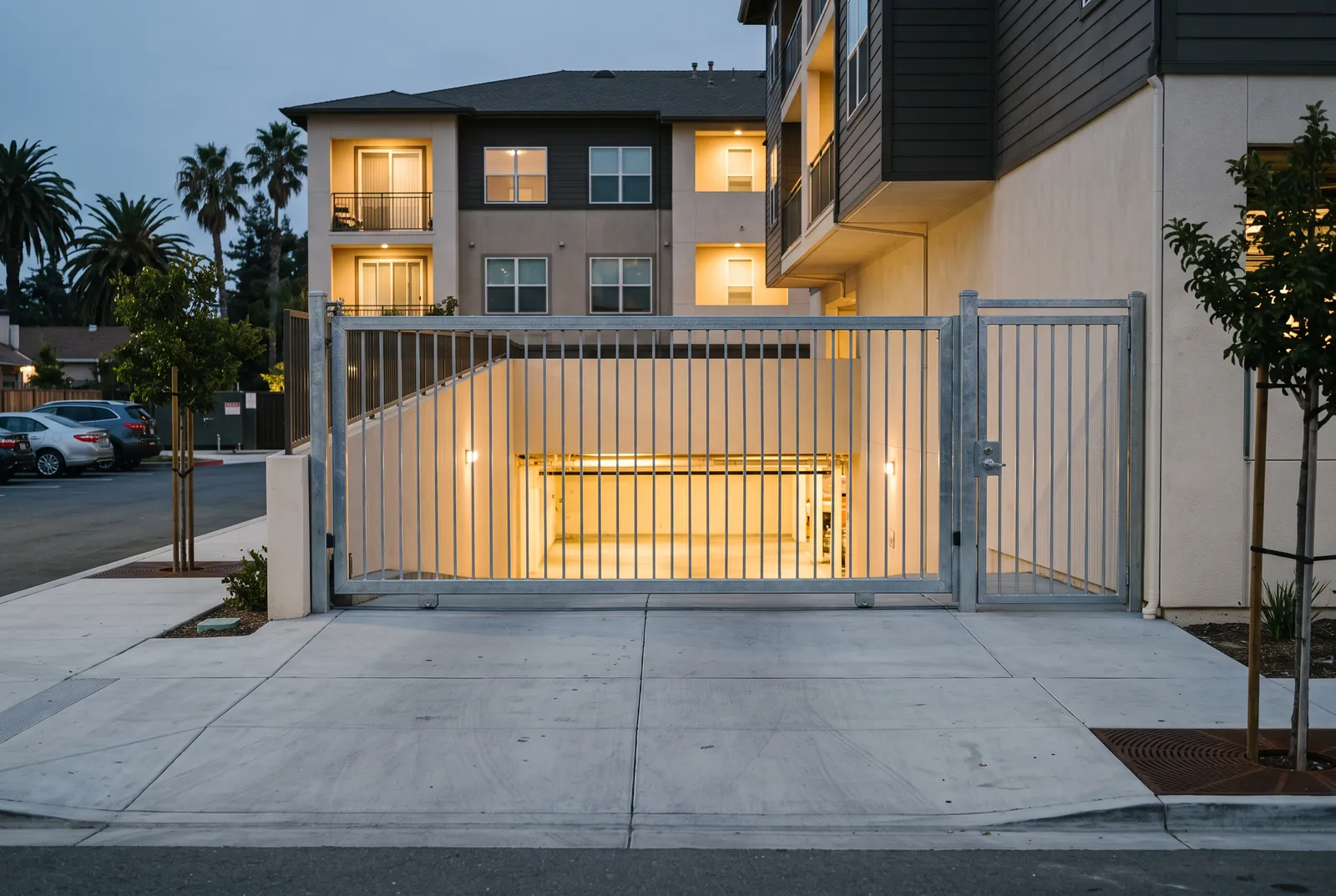
The ramp drops away from the street under a concrete lip with a yellow stripe painted across the entrance. At the top of it stands a pedestal with a small housing on a post at window height, and beyond that a leaf of steel mesh that is supposed to roll sideways into a pocket in the wall. You press the remote. Nothing. You press it out the window, closer, twice more, the way anybody would. A car comes up behind you and then a second one, and now there are three of you on a ramp with nowhere to turn around.
This is one of the most common calls that comes out of the newer blocks in the Transit Area and out of the condo streets around Hidden Lake Village, and it arrives at the two hours when the building is busiest: people leaving before seven and people coming back after nine. At those hours the lobby is empty, the office is shut, and nobody is walking past who can help. That is the ordinary shape of it here.
The first useful thing to know is that a gate is not a lock, and the second is that the most useful lock on the property is standing three feet to the side of it. Both of those change what you should be doing on a ramp at nine in the evening.
A gate is not one machine, it is six things in a row
Behind that moving leaf there is a motor with a gearbox, a chain or a rack that drives the leaf, a loop of wire buried in a saw cut in the concrete that senses a car sitting over it, a safety edge or a beam across the opening that stops the leaf if something is in the way, a receiver listening for remotes, and a keypad or call box on the pedestal. Six devices, each with its own power, its own wiring, and its own way of quitting on a wet night.
That is why a ramp gate fails more often than the garage door on a single-family house, and the reason is arithmetic rather than quality. A house door runs four cycles a day. A gate serving a hundred and twenty parking spaces runs several hundred, all of them outdoors, in dust, in rain, in wind that pushes on a large surface. It also has no single owner standing there noticing the early symptoms. The one resident who hears the motor hesitating for a week does not know who to tell, and nobody logs it.
The symptoms are worth knowing because they decide who you call. A leaf that opens and stops halfway, reverses, or shudders is usually the drive or the safety devices. A gate that ignores every remote in the building but opens from the keypad has a receiver or an antenna problem. A gate that opens fine for everyone except you has a remote problem. And a gate that is dead in every way at once is usually power, which is a building matter.
What is ours, and what plainly is not
Said as early in the call as possible, because it saves you an evening: gate motors, gearboxes, chains, sensing loops, safety beams, receivers and the electronics on the pedestal are the gate company's trade, not this one. The same goes for the springs, cables, panels and opener motors on a house garage door. A van that arrives and then explains it cannot do the actual job is worse than no van, so that gets settled on the phone.
What is this trade is everything mechanical you can put a key into. The walk-in gate beside the ramp, with a cylinder in a latch inside a steel frame. The door from the garage into the stairwell or the elevator lobby. The utility and trash room doors down there. The mail block in the corner of the lobby and the little cabinet doors in it. A padlock on a storage cage. A cylinder on the swing gate at the side of the building. On the electronic doors, the mechanical part underneath stays ours and the list of who is switched on stays the building's.
One more boundary worth naming. Programming the building's own openers, adding or removing somebody from the system, and clearing a gate receiver are jobs for whoever maintains that system. A locksmith who offers to do it over the phone is promising something he does not hold. Car remotes are a different matter entirely and they do sit here, at $94 to $199 for programming.
Who orders work on a gate that belongs to everybody
This is the question that decides how the evening goes, and it gets settled on the call rather than on the ramp. A shared entrance serves the whole building, so before a van is sent we ask who is authorizing the work and take that from them, in writing where it matters. Nothing on this page is a ruling about who that person is. It is a matter between you and your building, and the people who manage it are the ones who know how it works there.
In practice the conversation is short. Some buildings have a maintenance number that answers at night and authorizes work on the spot. Some want everything through an office in the morning. Some have a standing arrangement with a gate contractor and want nobody else touching it, which is a perfectly sensible position and one we will not argue with at eleven at night.
Your own front door is the simple half of this and it is worth separating out loud. On the door of the unit you live in, the work starts when you say so, with identification checked at the door. A house lockout there is $129 to $246 with the $89 service call inside the figure. On a shared entrance opened at the building's instruction, it is a business lockout at $142 to $265. The difference in those two numbers is smaller than the difference in how the two calls actually proceed.
The walk-in gate three feet away is the one that matters
Nearly every vehicle gate on a ramp has a pedestrian gate beside it, often on the sidewalk a few steps up the slope. It is a steel frame with a latch and a plain cylinder in it, and when the big leaf is not moving it is the way in and out of the garage on foot. It is also the way a technician reaches your car when the gate is dead, and the way you get to the elevator lobby without walking around the block.
It is also the stiffest lock on the property, and there is a reason. It stands outdoors with weather on both faces, it takes sun on a steel frame that gets far hotter than the air, and the grit that blows down a ramp settles into a vertical keyway like sand into a jar. Most of them have not been serviced since the building was handed over. A great many have no cut key anywhere on site, because the one that came with the gate went into an envelope years ago.
Putting one back in service is not expensive and it is the highest value hour anybody spends in a garage. The cylinder comes out, gets cleaned dry rather than flooded with a general purpose spray, gets new pins and a key cut to match at $30 to $47, and goes back so it turns with two fingers. Where the shell or the cam is worn past that, replacement is $126 to $338, and where it is a glass door in an aluminum frame on the way into the lobby, that hardware is $159 to $486.
The car on the wrong side of a gate that is not moving
Two versions of this land on the phone in the same week. In the first, you are outside with the groceries and the car and the key are on separate sides of a dead gate. In the second, the key is on the driver's seat and the car is on level two, and the technician cannot reach it because the way in needs the thing that is locked inside the car.
For the second one, say on the call that the car is behind a gate. It changes how the visit starts: somebody has to meet the technician at the walk-in gate or at the lobby, and that is thirty seconds of planning that saves twenty minutes of standing around. A car lockout is $106 to $199 with the $89 inside it, and the figure does not move because the car was underground, but the visit takes longer if nobody arranged the way in.
If the key is not locked in but gone, that is different work and it happens where the car is parked rather than anywhere else: a replacement key is $156 to $429, remote programming $94 to $199, and an ignition that turns and leaves the dash dead is $186 to $468. Identification and the paperwork get matched to the plate before any blank goes into a machine, which is the part that makes the trade worth having.
Three questions to ask on a Saturday afternoon
Ask them in daylight, with nothing urgent attached, and the answers are worth more than any preparation on this page. One: where exactly is the walk-in gate beside the ramp, and does the key you carry open it. Try it rather than assume it. Two: does the door from the garage into the stairwell or lobby have a cylinder in it, and is there a key for that on your ring. Three: what number gets answered at night by somebody who can authorize work on a shared entrance.
Buildings that can answer all three generate almost no calls like this. Buildings that cannot generate one a year, always in the dark, usually when the office is closed. Asking costs you a walk down a ramp.
And when you do call, name the thing precisely. Vehicle gate, walk-in gate, garage-to-lobby door, unit door: four different jobs, four different answers, and one of them is not this trade at all. Arrival averages 18 minutes across the city from the base near Main Street, with the Transit Area at 14 and Hidden Lake Village at 19. Evenings between 8pm and midnight carry $48, overnight between midnight and 7am carries $86, said before anyone drives. Ninety days on the labor.
Quick answers
The gate at the garage entrance will not open. Can you fix it?+
Not the gate itself. The motor, the drive, the sensing loop in the concrete, the safety beam and the pedestal electronics are the gate contractor's work and we say so on the phone rather than after driving over. The walk-in gate beside the ramp, the garage-to-lobby door and any cylinder down there are ours, and those are usually what actually gets you and your car moving.
Who has to order the work on a shared gate or lobby door?+
That gets settled on the call, before a van is sent. A shared entrance serves the whole building, so we ask who is authorizing the work and take it from them. It is a question between you and the people who manage your building, and not something we decide on your behalf. Your own unit door is simpler: identification at the door and the work starts when you say so.
My car is parked under the building and the key is inside it. Does that cost more?+
No. A car lockout is $106 to $199 with the $89 service call inside the figure, underground or at a curb. What changes is the logistics, so mention the gate when you call: somebody has to meet the technician at the walk-in gate or the lobby, and arranging that in advance is the difference between a short visit and a long one.
Need it handled rather than read about?
(669) 330-0824More guides